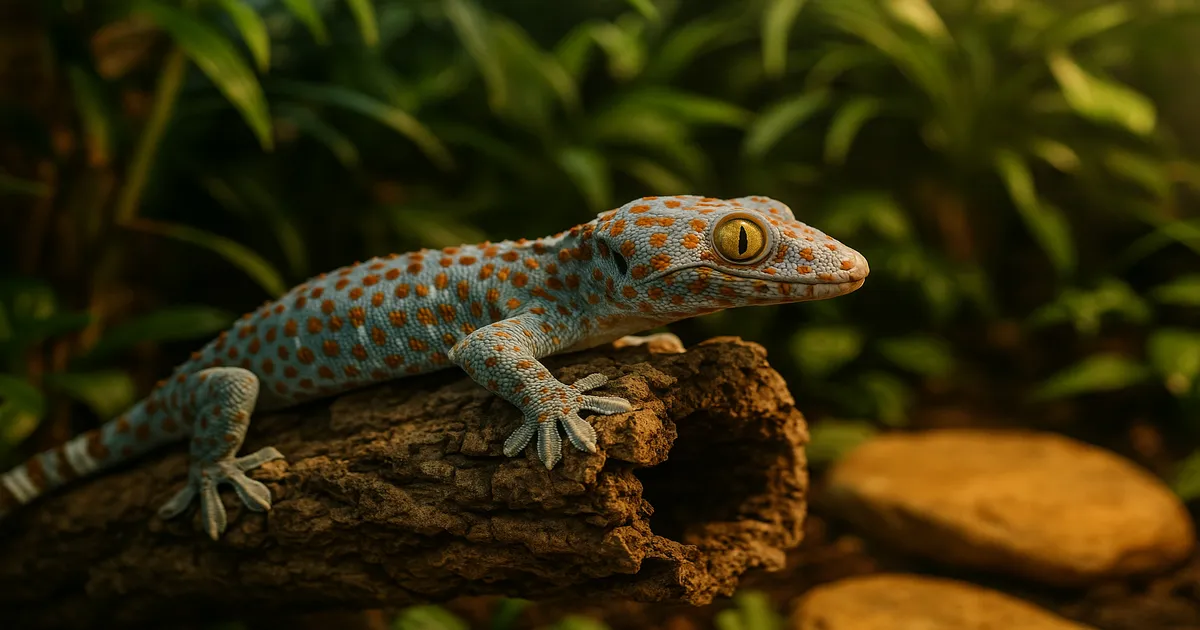
Quick Answer: Yes, tokay geckos absolutely need supplemental heat in virtually all indoor captive settings. They’re tropical animals from Southeast Asia where daytime temps regularly hit 85–95°F (29–35°C) and nights rarely drop below 65°F (18°C) — your 70°F living room doesn’t cut it. Without proper heat, they’ll suffer digestive failure, immune suppression, and a dramatically shortened life.
If you’re wondering whether tokay geckos need heat, the short answer is an emphatic yes — and it’s one of the most consequential things to get right with this species. Tokays are often sold as “tough” or “beginner-friendly,” which is misleading at best. They’re hardy in the sense that they won’t immediately keel over from neglect, but chronic low temperatures will grind them down quietly until it’s too late. I’ve seen keepers lose otherwise healthy animals to nothing more exotic than a cold room.
Understanding Tokay Gecko Temperature Needs
Wild Habitat and Natural Temperature Range
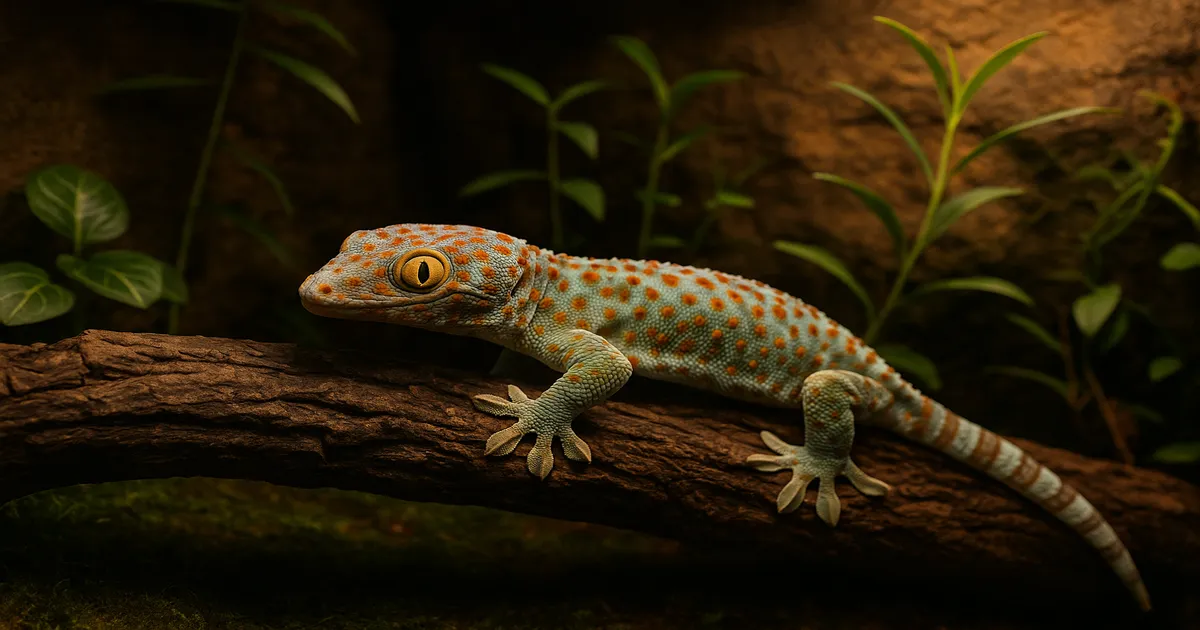
Tokay geckos (Gekko gecko) are native to a broad swath of tropical Southeast and South Asia — Thailand, Vietnam, Indonesia, the Philippines, southern China, and beyond. Their natural habitat ranges from dense rainforest to rocky cliff faces to the walls and ceilings of human buildings. Remarkably adaptable in terms of habitat, but not in terms of climate. Wherever they live, it’s hot and humid.
Daytime ambient temperatures in their range regularly sit between 85–95°F (29–35°C), and nighttime temps rarely dip below 65°F (18°C). That’s the thermal window you’re trying to replicate.
Why Tokays Are Arboreal — and Why That Changes Everything
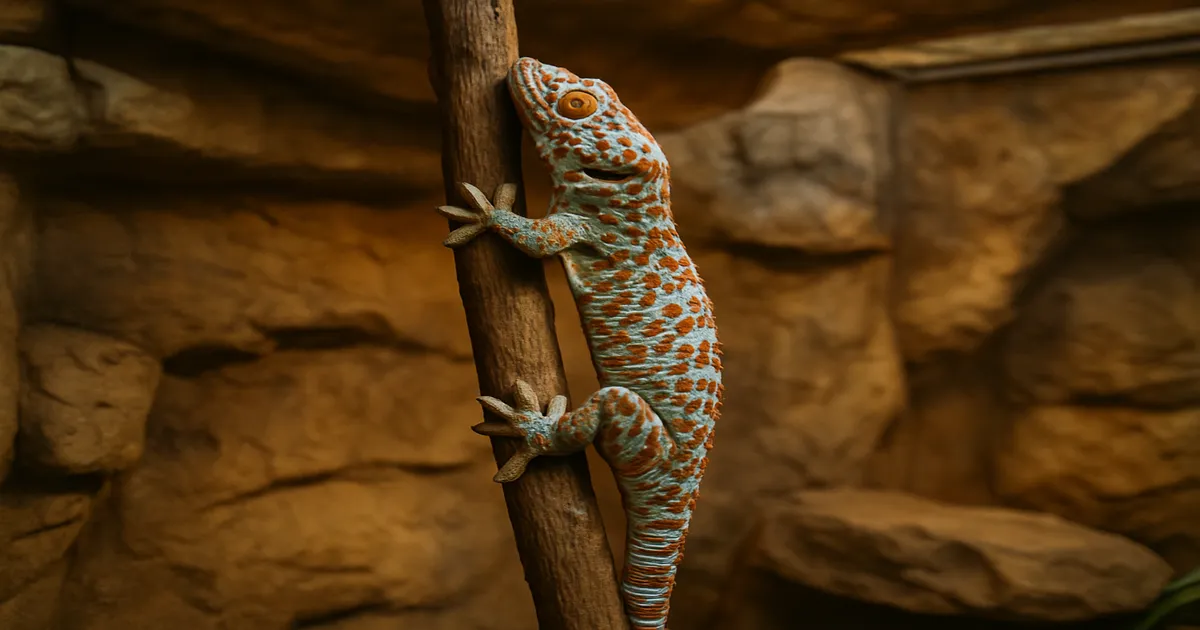
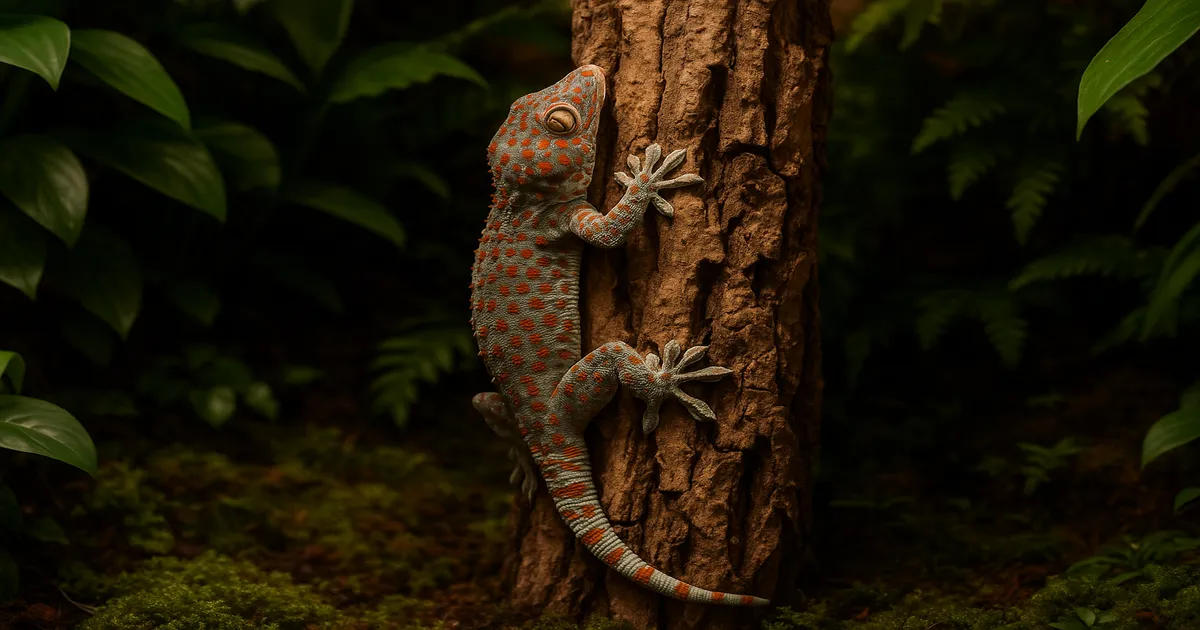
This is where a lot of keepers go wrong, especially those coming from experience with leopard geckos or other terrestrial species. Tokays don’t thermoregulate on the ground. They do it vertically — pressed flat against sun-warmed tree trunks, building walls, and rocky outcroppings up high. That fundamentally changes how you need to deliver heat.
A floor-level heat source is nearly useless for a tokay. They’ll spend most of their time elevated, and if the heat isn’t up there with them, they simply can’t thermoregulate effectively.
The Vertical Thermal Gradient
The setup you’re aiming for is warm at the top, cooler at the bottom. A tokay that’s too warm moves down; one that’s too cool moves up. This vertical thermal gradient lets them self-regulate in exactly the same way they would in the wild. It’s completely different from the horizontal gradient you’d set up for a leopard gecko, and it requires different equipment placement and enclosure choices.
Tokay Gecko Temperature Parameters at a Glance
| Zone | Temperature |
|---|---|
| Basking spot | 90–95°F (32–35°C) |
| Warm/upper ambient | 82–88°F (28–31°C) |
| Cool/lower ambient | 72–78°F (22–26°C) |
| Nighttime low | 68–75°F (20–24°C) — never below 65°F (18°C) |
The basking spot must be positioned high in the enclosure — top third at minimum. A basking zone down low will be ignored.
The upper portion of the enclosure should hold at 82–88°F (28–31°C) ambient, while the lower portion can run cooler at 72–78°F (22–26°C). That spread is what gives your gecko meaningful thermoregulatory choice. A 5–10°F (3–6°C) drop at night is completely natural and actually beneficial — it mimics the diurnal cycle of tropical climates and can support breeding behavior. Just don’t let it fall below 65°F (18°C). Below that, you’re looking at immune suppression and digestive slowdown.
How Humidity Works Alongside Heat
Heat and humidity aren’t separate concerns — they work together. Target 60–80% relative humidity with brief spikes to 80–90% during misting. If humidity chronically drops below 50%, you’ll see dysecdysis (stuck sheds), respiratory problems, and dehydration. Daily misting is non-negotiable.
Best Heating Equipment for Tokay Geckos
Radiant Heat Panels
Radiant heat panels mount inside the top of the enclosure and emit gentle, even warmth downward. They’re one of the best primary heat sources for tokays — no light output, consistent heat, and they work well with a pulse thermostat. No light means no disruption to their nocturnal behavior, which matters more than most keepers realize.
Halogen and Incandescent Basking Bulbs
A 25–40W halogen flood or incandescent bulb positioned at the top of the enclosure creates a solid localized basking zone. These need to be paired with a dimming thermostat — running them uncontrolled is a recipe for overheating. Low-wattage halogens are reliable, cheap, and easy to dial in. (Herpstat 1)
Ceramic Heat Emitters
CHEs produce heat without any light, which makes them ideal for 24-hour supplemental heat and nighttime warmth. Pair with a pulse or on/off thermostat. They’re not the most sophisticated option, but they’re dependable and inexpensive — a perfectly reasonable choice for a budget setup.
Deep Heat Projectors
The Arcadia Deep Heat Projector is genuinely excellent. It penetrates tissue more deeply than surface radiant heat, providing more biologically effective warmth. Mount it at the top of the enclosure. It’s pricier than a CHE, but for a long-term setup it’s worth every penny.
Why Under-Tank Heaters Are the Wrong Choice
I’ll be blunt: UTHs are the wrong tool for tokay geckos. They heat the floor — the coolest zone in a vertical setup, the place your tokay spends the least time. Using one as your primary heat source is like putting the radiator in the basement of a two-story house. If you already own a heat mat, mount it on the back wall of the enclosure and control it with a thermostat. That’s a far better use of the same equipment.
Thermostats — Non-Negotiable
No heating element should ever run without a thermostat. An uncontrolled CHE or basking bulb can push temperatures above 100°F (38°C) and kill your gecko fast.
- Dimming/proportional thermostat: For halogen and incandescent bulbs (Herpstat 1)
- On/off thermostat: For CHEs and DHPs (Inkbird ITC-308)
- Pulse thermostat: For RHPs and CHEs (Vivarium Electronics VE-300X1)
Place the probe at the basking zone, not hanging in mid-air.
Setting Up Heat in a Tokay Gecko Enclosure
Choosing the Right Enclosure
Front-opening glass terrariums are the best all-around choice — they retain humidity, allow a proper vertical setup, and reduce stress during maintenance since you’re not reaching in from above. PVC enclosures retain humidity even better and are worth considering for serious setups. Avoid purely screen enclosures — they can’t hold heat or humidity, full stop.
Minimum size for an adult is 18” × 18” × 24” (45 × 45 × 60 cm), but push for 24” × 18” × 36” (60 × 45 × 90 cm) if you can. Vertical height is the priority with this species.
Creating the Vertical Thermal Gradient
Mount your primary heat source at the top of the enclosure. Then mount a flat piece of cork bark on the upper back wall and direct your heat source at it. Tokays will press themselves flat against that warm vertical surface for hours — that’s genuine thermoregulation happening, and it replicates exactly how they bask in the wild. A horizontal basking spot is far less effective for this species.
The bottom third of the enclosure should stay noticeably cooler. Don’t try to heat the whole enclosure uniformly — that removes your gecko’s ability to thermoregulate, which is the opposite of helpful.
Measuring Temperatures Accurately
Use digital probe thermometers at both the warm and cool ends of the enclosure. More importantly, use an infrared temperature gun to verify actual surface temperatures — surfaces can run 10–15°F (6–8°C) warmer than the surrounding air, and that’s what your tokay is actually contacting. (Etekcity Lasergrip 774) Probe readings alone will mislead you.
Common Heating Mistakes to Avoid
Using only an under-tank heater. UTHs heat the floor. Tokays live up high. This setup provides almost no thermoregulatory benefit for an arboreal gecko.
Running heat without a thermostat. Uncontrolled heat sources can push enclosure temperatures to fatal levels. This isn’t a theoretical risk — it happens, and it kills geckos quickly.
Relying on room temperature alone. A room at 68–72°F (20–22°C) feels comfortable to you but it’s too cold for a tokay without supplemental heat. Even in summer, most homes don’t stay warm enough.
Placing the basking spot too low. Tokays won’t use a ground-level basking spot. If your heat source is at the bottom of the enclosure, your gecko is essentially living without a functional basking zone.
Eliminating the cool zone. Heating the entire enclosure uniformly sounds thorough, but it removes your gecko’s ability to self-regulate. Always maintain a genuine cool retreat at the bottom.
Pro Tips for Heating Tokay Geckos Effectively
The two-hide rule. Always provide one hide in the warm zone and one in the cool zone. If your gecko is always in the cool hide, your warm zone is too hot. If it never touches the cool hide, your gradient is insufficient. Gecko behavior tells you more than any thermometer.
Use a temp gun, not just probes. Probe thermometers measure air temperature. Your tokay thermoregulates by contact with surfaces. Those two numbers are not the same. Check what your cork bark is actually sitting at — you might be surprised.
Nighttime drops can trigger breeding. If you want to breed tokays, a consistent drop to 68–72°F (20–24°C) at night combined with a dry-season simulation — reducing misting frequency for 4–6 weeks in winter — can reliably trigger breeding behavior. Constant year-round tropical conditions actually work against you here.
Budget setups work fine. A 40W incandescent bulb on a simple on/off thermostat is a functional basking heat source that costs almost nothing. A reptile heat mat mounted on the back wall and controlled by a thermostat is another solid budget option. You don’t need to spend a fortune to do this right.
Don’t assume warm climates exempt you. If you’re in Florida, Hawaii, or anywhere with consistently warm ambient temps, you might think you can skip supplemental heat. Maybe — but air conditioning can drop indoor temps below safe thresholds even in tropical climates. A low-wattage CHE on a thermostat is cheap insurance year-round.
Frequently Asked Questions About Tokay Gecko Heat
Do tokay geckos need heat lamps specifically, or will other heat sources work?
They don’t need a lamp specifically — what they need is a heat source positioned high in the enclosure that creates a proper basking zone. Radiant heat panels, deep heat projectors, and halogen bulbs all work well. The key is placement (top of the enclosure) and thermostat control, not the specific type of heat source.
How cold is too cold for a tokay gecko at night?
Anything below 65°F (18°C) is too cold and risks serious health consequences. Nighttime temps should ideally stay between 68–75°F (20–24°C). A 5–10°F drop from daytime temperatures is natural and healthy; anything beyond that starts causing problems.
Can tokay geckos survive without supplemental heat?
Not reliably. In most indoor environments, ambient room temperature isn’t sufficient to meet their thermal needs. Without supplemental heat, tokays will experience slowed digestion, immune suppression, and lethargy — and chronic exposure to low temperatures will shorten their lifespan significantly.
What’s the best heater for a tokay gecko enclosure?
Radiant heat panels or deep heat projectors mounted at the top of the enclosure are the best primary heat sources for tokays. They provide consistent overhead warmth that suits the species’ arboreal habits. Whatever you use, it must be controlled by a thermostat — no exceptions.
Do tokay geckos need heat at night?
They need the enclosure to stay within a safe range — 68–75°F (20–24°C) is ideal. If your room drops below that after dark, a ceramic heat emitter on a thermostat is the cleanest solution since it produces no light. A deep heat projector works equally well for nighttime heat without disrupting their nocturnal activity.